Part 1: Vector-Valued Functions
Now that we have introduced and developed the concept of a vector, we are
ready to use vectors to define functions. To begin with, a vector-valued function is a function whose inputs are a parameter t and whose outputs are vectors r( t) .
In 2 dimensions, a vector-valued function is of the form
Moreover, the set of position vectors of the form r( t) =
á f( t) ,g( t)
ñ for t in [ a,b] forms a curve whose orientation is in the
direction in which the parameter is increasing. The point (f(a),g(a)) is called the initial point of the curve, and the
point (f(b),g(b)) is the curve's terminal point.
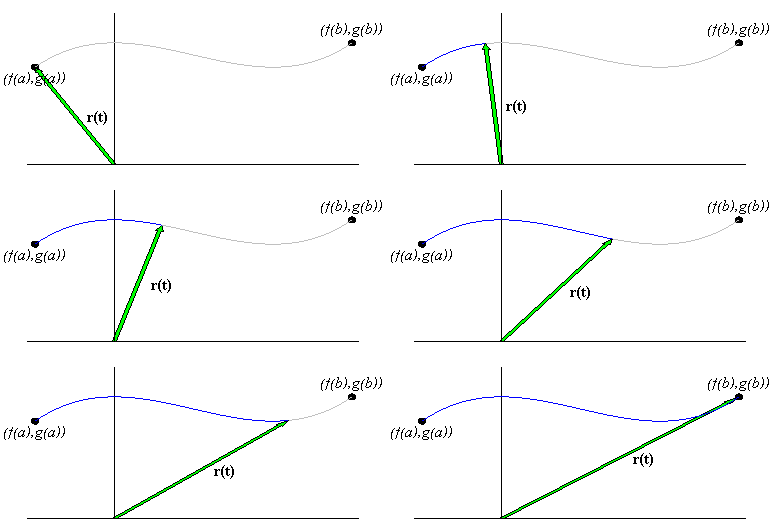 |
|
click to toggle animation |
|
The function r( t) =
á f(t) ,g( t)
ñ , t in [ a,b] , is
called a parametrization of the curve, and in order to sketch the
curve, we often let
|
x = f( t) , y = g( t) , t in [ a,b] |
|
and then eliminate the parameter t in hopes of obtaining a familiar
equation in x and y.
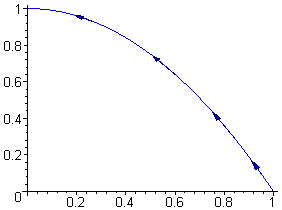
EXAMPLE 1 Sketch the curve parametrized by r(t) =
á 1-t2,2t2-t4
ñ for t in [ 0,1] .
Solution: To begin with, x = 1-t2, which means that t2 = 1-x.
Since y = 2t2-t4, that means that
which simplifies to y = 1-x2. Moreover, the initial and terminal points
are
That is, the graph of r( t) =
á1-t2,2t2-t4
ñ for t in [ 0,1] is the
section of the graph of y = 1-x2 between the initial point (1,0) and the terminal point ( 0,1) .
Check your Reading: How would we simplify (1) to y = 1-x2?