The domain of a function of 2 variables f, which is denoted dom( f) , is the set of all points ( x,y) in the xy-plane for which f( x,y) is defined. Moreover, dom( f) is often written in set notation, where { } represents the phrase ``is the set of'' and | represents the phrase "such that.'' For example,
|
EXAMPLE 3 Determine the domain of f( x,y) = ln( y-2x)Solution: Since the argument of ln(.) must be positive, the domain of f is the set of points ( x,y) for which the denominator is not equal to 0. However,
In set notation this is written as dom( f) = { (x,y) | y > 2x} .
y-2x > 0 means that y > 2x
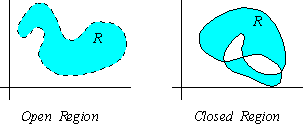
In this text, most of the sets in the xy-plane we encounter will be bounded by a closed curve. As a result, we define an open region to be the set of all points inside of but not including a closed curve, and we define a closed region to be the set of all points inside of and including a closed curve.
Equivalently, a point ( p,q) is said to be a boundary point of a set R if any circle centered at ( p,q) contains both points inside of and outside of R,
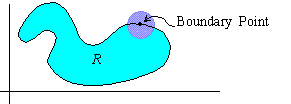
and correspondingly, a set R is open if it contains none of its boundary points and closed if it contains all of its boundary points.
EXAMPLE 4 Determine if the domain of the following function is open or closed.
f( x,y) =
9-x2-y2 Solution: To begin with, the quantity 9-x2-y2 cannot be negative since it is under the square root. Thus, the domain of f is the set of points that satisfy
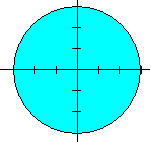
That is, the domain is the set of points ( x,y) inside the circle of radius 3 centered at the origin, which we write as
9-x2-y2 ³ 0 or 9 ³ x2+y2
dom( f) = { ( x,y) | x2+y2 £ 9} Moreover, the domain is a closed region of the xy-plane since it contains the boundary circle of radius 3 centered at the origin: