Constraints that are not Closed Curves
The Lagrange multiplier method is a means of
finding the extrema of z(t) = f(x(t), y(t)) when the constraint g(x,y) = k
is
parametrized by r(t) =
á x(t), y(t)
ñ , t in [ a,b] . Thus, if
z(t) is continuous on [a,b], then z(t) must attain an
absolute maximum and an absolute minimum somewhere on r(t) =
á x(t), y(t)
ñ , t in [ a,b] , although it is possible that extrema will occur
at the endpoints of a constraint.
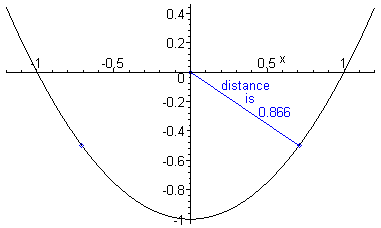
EXAMPLE 2 Find the point(s) on the curve y = x2-1 closest
to the origin.
Solution: If we let f( x,y) be the square of the
distance from a point ( x,y) to the origin ( 0,0), then we are seeking to minimize
subject to the constraint x2-y = 1. Moreover, any point (x,y) with x ³ 1 is more than one unit from the origin, so we need
only find the absolute minimum over the section of the curve y = x2-1 for
which x is in [ -1,1] .
The gradients of f and g( x,y) = x2-y are
|
Ñf =
á 2x,2y
ñ , Ñg =
á2x,-1
ñ |
|
Thus, the Lagrange multiplier problem is
|
2x = l2x, 2y = -l, x2-y = 1 |
|
To eliminate l, we use the second equation to replace l in
the first equation,
If x = 0, then y = -1. Thus, ( 0,-1) is the critical point
corresponding to l = -1. If x ¹ 0, then 1 = -2y so that y = -1/2
and
|
x2- |
-1
2
|
= 1, x = |
±1
Ö2
|
, |
|
Thus, the critical points are ( 0,-1) , ( 1/Ö2,-1/2) and ( -1/Ö2,-1/2) . However,
|
f( -1/Ö2,-1/2) = f( 1/Ö2,1/2) = |
3
4
|
, f( 0,1) = 1 |
|
Consequently, the points on y = x2-1 which are closest to the origin are
|
|
æ
è
|
|
-1
Ö2
|
, |
-1
2
|
ö
ø
|
and |
æ
è
|
|
-1
Ö2
|
, |
-1
2
|
ö
ø
|
|
|
and these points are Ö(3/4) = 0.866 units from the origin.
Nearly all of the optimization problems considered earlier in an
introductory calculus course are constrained optimization problems. Thus,
they can often be solved using the method of Lagrange multipliers.
EXAMPLE 3 Suppose John wants to start a kennel by building 5
identical adjacent rectangular runs out of 400 feet of fencing (see diagram
below), Find the dimensions of each run that maximizes its area.
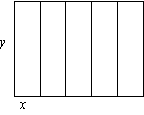
Solution: We let A denote the area of a run, and we let x,y be
the dimensions of each run. Clearly, there are to be 10 sections of fence
corresponding to widths x and 6 sections of fence corresponding to lengths
y. Thus, we desire to maximize A = xy subject to the constraint
Since x and y cannot be negative, we need only find absolute extrema for
x in [ 0,40] . If we let g( x,y) = 10x+6y, then
the gradients of A and g are
|
ÑA =
á y,x
ñ , Ñg =
á10,6
ñ |
|
As a result, the Lagrange multiplier problem becomes
|
y = 10l, x = 6l, 10x+6y = 400 |
|
Solving for l in the first two equations yields l = y/10 and
l = x/6. Thus,
|
|
y
10
|
= |
x
6
|
, y = |
10x
6
|
= |
5x
3
|
|
|
Substituting into the constraint thus yields
|
10x+6 |
æ
è
|
|
5x
3
|
ö
ø
|
= 400, x = 20 feet |
|
Moreover, we also have y = 5·20/3 = 100/3 = 33. 33 feet.
Check Your Reading: What is the value of the Lagrange
multiplier in this last problem?