![[Maple Bitmap]](images/3-21.gif)
Parametric Surfaces
A function of the form r (u,v) = < f ( u,v ) , g ( u,v ) , h ( u,v ) > maps a region in the uv -plane to a surface in the xyz -coordinate system and is correspondingly a parametrization of that surface.
Often we write the parametrization in the form of 3 equations:
x = f ( u,v ), y = g ( u,v ), z = h ( u,v )
and then we seek to find a level surface representation of that surface.
For example, r ( u,v ) = < cos( u ) cosh( v ), sin( u ) cosh( v ), sinh( v ) > can also be written in the form
x = cos( u ) cosh( v ), y = sin( u ) cosh( v ), z = sinh( v )
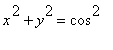
However, notice now that
 (
u
)
(
u
)
 (
v
) +
(
v
) +
 (
u
)
(
u
)
 (
v
) =
(
v
) =
 (
v
). As a result, we have
(
v
). As a result, we have
 (
v
) -
(
v
) -
 (
v
) = 1
(
v
) = 1
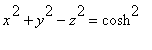
which implies that r ( u,v ) = < cos( u ) cosh( v ), sin( u ) cosh( v ), sinh( v ) > is a hyperboloid.
To graph r ( u,v ) using Maple , we use the command "plot3d" in the form
plot3d([ f ( u,v ) , g ( u,v ) , h ( u,v ) ], u = a..b, v = c..d);
Let's look at the plot of our hyperboloid above.
> plot3d([cos(u)*cosh(v),sin(u)*cosh(v),sinh(v)],u=0..2*Pi,v=-1..1);
Let's look at some other examples of Maple's ability to plot parametric surfaces.
Let's begin with the sphere:
> plot3d([cos(u)*cos(v),sin(u)*cos(v),sin(v)],u=0..Pi,v=-Pi..Pi);
Here is the parametric equation of a Torus
> plot3d([(2+sin(v))*cos(u),(2+sin(v))*sin(u),cos(v)],u=0..2*Pi,v=0..2*Pi,grid=[20,20],scaling=constrained);
Here is the parametric equation of a Mobius strip, which is a surface with only one side!
> plot3d([2*cos(u)+v*cos(u/2),2*sin(u)+v*cos(u/2),v*sin(u/2)],u=0..4*Pi,v=0..1,grid=[40,10]);
Also interesting is the fact that we can create surfaces of revolution: To create the surface of revolution of y=f ( x ) for x in [ a,b ] obtained by revolving the curve about the x -axis, we use the parametrization
r ( u,v ) = < v,f ( v )sin( u ), f ( v )cos( u )>
Let's look at an example: First, let us look at the curve we will revolve.
> plot(4*x*exp(-x),x=0..4,color=black,scaling=constrained);
Now let's look at its surface of revolution about the x-axis.
> plot3d([v,4*v*exp(-v)*sin(u),4*v*exp(-v)*cos(u)],u=0..2*Pi,v=0..4,axes=normal,scaling=constrained,orientation=[-90,56]);
>
Let's animate this process so you can better understand what it means for a curve to be revolved to produce a surface of revolution.
>
sur_rev[0]:=spacecurve([v,0,4*v*exp(-v)],v=0..4,thickness=2,color=black):
for i from 1 to 20 by 1 do
temp1:=spacecurve([v,-4*v*exp(-v)*sin(i/10*Pi),4*v*exp(-v)*cos(i/10*Pi)],
v=0..4,thickness=2,color=black):
temp2:=plot3d([v,-4*v*exp(-v)*sin(u),4*v*exp(-v)*cos(u)],u=0..i/10*Pi,v=0..4):
sur_rev[i]:=display(temp1,temp2):
end do:
display(seq(sur_rev[i],i=0..20),insequence=true,axes=normal,orientation=[-71,54]);
>