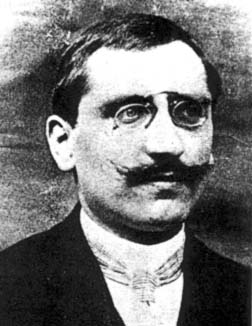
Henri Lebesgue, 1875-1941
COURSE: MATH 5210-001
TIME: 4:40-6:00 MW, PLACE: Room 476 of Brown Hall
INSTRUCTOR: Dr. Robert Gardner, OFFICE: Room 308F of Gilbreath Hall
OFFICE HOURS: 9:00-10:00 TR, PHONE: 439-6979 (Math Office 439-4349)
E-MAIL: gardnerr@etsu.edu
WEBPAGE: http://www.etsu.edu/math/gardner/gardner.htm
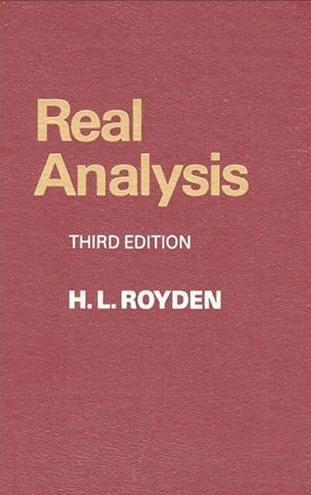
TEXT: Real Analysis, Third Edition, by H. L. Royden.
ABOUT THE COURSE: This class offers a standard introduction to the theory of functions of a real variable from the measure theoretic perspective. As commented on page 1 of the text, we will cover "a portion of the material that every graduate student in mathematics must know." Whereas the undergraduate real analysis class presents the results of calculus from a rigorous perspective, we will introduce fundamentally new ideas which are basic extensions of the results from calculus. In particular, we will put a weight or ``measure'' on certain sets of real numbers. This measure will be used to define a new type of integral called the Lebesgue integral. Recall that a function is Riemann integrable if and only if it is discontinuous on a "small" set (namely, a set of measure zero). The Lebesgue integral is much more flexible and will allow us to integrate a much larger class of functions. In addition, we will have a number of "convergence theorems" related to the Lebesgue integral, which are not true in the setting of Riemann integration.
GRADING: We will have two tests (T1 and T2) and homework (HW) will be taken up a regular intervals (weekly). Your average will be computed as follows:
A NOTE ABOUT HOMEWORK: While I suspect that you may work with each other on the homework problems (in fact, I encourage you to), I expect that the work you turn in is your own and that you understand it. Several of the homework problems are fairly standard for this class, and you may find proofs online. However, the online proofs may not be done with the notation, definitions, and specific methods which we are developing and, therefore, are not acceptable for this class.
TENTATIVE OUTLINE:
Chapter 1: Set Theory (Sections 4, 5, and 6).
algebra of sets, σ-algebras, axiom of choice, countable sets,
rational numbers.
Chapter 2: The Real Number System (Sections 1,2 3, and 7).
axioms of the real numbers, completeness, natural numbers, rational
numbers, extended real numbers, Borel sets.
Chapter 3: Lebesgue Measure.
outer measure, measurable sets, Lebesgue measure, measurable functions,
characteristic functions, Littlewood's principles, Egoroff's Theorem,
Lusin's Theorem.
Chapter 4: The Lebesgue Integral.
Riemann integral, step functions, simple functions, Lebesgue integral of a
bounded function, Bounded Convergence Theorem, Fatou's Lemma, Monotone
Convergence Theorem, Lebesgue Convergence Theorem, general Lebesgue
Integral, Convergence in measure.
Chapter 5: Differentiation and Integration.
monotone functions, bounded variation, differentiation of an integral,
absolute continuity, convex functions, Jensen's Inequality.
IMPORTANT DATES:
| |
|||
Return to Bob Gardner's home page