The Directional Derivative
Let p = ( x0,y0) be fixed and let u =
á m,n
ñ be a unit vector. Then a vertical slice of z = f( x,y) is the curve formed by the
intersection of the vertical plane through the line r(t) = p+ut and the surface z = f( x,y) . In
particular, z( t) is the height of the surface z = f(x,y) at the point r( t) .
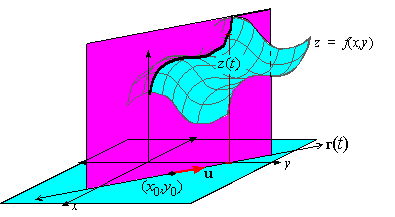
Since u is a unit vector, the point r( h)
is a distance h from r( 0) . Thus, a run of h
causes a rise of z( h) -z( 0)
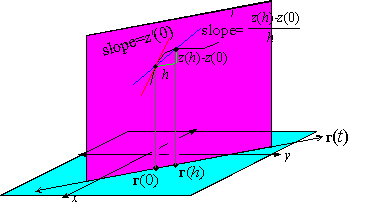
It follows that the slope of the tangent line at r( 0)
is
|
slope = |
lim
h® 0
|
|
z( h) -z( 0)
h
|
|
|
which is simply z' ( 0) . However, r'
( 0) = u and the chain rule yields
|
z' ( 0) = |
dz
dt
|
ê
ê
|
t = 0
|
= Ñf·r' ( 0) = Ñf·u |
|
That is, the slope of the tangent line is Ñf·u, where u is a unit vector in the direction of r( t) .
Definition 6.1 The directional derivative of f(x,y) in the direction of a unit vector u is denoted by Duf and is defined to be
In particular, Duf is the slope of the tangent line to the
curve formed by the intersection of z = f( x,y) and the vertical
plane through a point p parallel to a unit vector u.
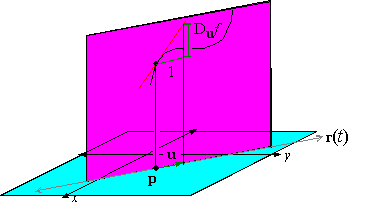
For example, the ordinary partial derivatives are special cases of
Duf:
|
|
¶f
¶x
|
= Dif and |
¶f
¶y
|
= Djf |
|
That is, fx yields slopes of vertical slices in the xz-plane and fy yields slopes of vertical slices in the xy-plane.
EXAMPLE 3 Find the derivative of f( x,y) =
1.1x2 - 0.1xy in the direction of v =
á 3,4
ñ.
Solution: Since v is not a unit vector, we first finds
its direction vector:
|
u = |
1
v
|
v = |
1
5
|
á 3,4
ñ = |
|

|
3
5
|
, |
4
5
|

|
=
á 0.6, 0.8
ñ
|
|
The gradient of f is Ñf =
á 2.2x - 0.1y, -0.1x ñ, so that
|
Du f |
= |
á 2.2x - 0.1y, -0.1x
ñ ·
á 0.6, 0.8
ñ |
|
= |
0.6( 2.2x - 0.1y)
+ 0.8
(-0.1x ) |
|
= |
1.24x - 0.06y |
|
Check your Reading: What is Du f at the
point ( 1,0) ?