DIFF GEOM: The Poincare Half-Plane
The fundamental form can also be used to study surfaces which
cannot be constructed in ordinary space. In particular, we can define a
new geometry on the plane by giving it a non-Euclidean
fundamental form. This is exactly what Henri' Poincare' did in order to
study hyperbolic geometry, which is geometry in which there are
infinitely many parallel lines to a line l through a point not on l
itself.
Specifically, Poincare modeled hyperbolic geometry by assigning the
fundamental form
to the upper half of the uv-plane. The result is called the Poincare
half-plane and has a unique geometry that differs appreciably from the usual half-plane.
That is, distances between ( u,v) points are now defined by (3), so that the length of a curve
á u(t) ,v( t)
ñ , t in [ a,b] , is
given by
or equivalently for functions v = f( u) , by the integral
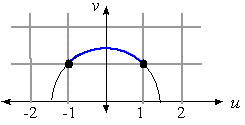
For example, the shortest path between the points ( -1,1) and ( 1,1) is not a straight line under the Poincare metric (3).
Because distances become shorter as v
increases, the shortest path between ( -1,1) and (1,1) is a curve with an intercept greater than v = 1.
EXAMPLE 6 Compute the distances from ( -1,1) to ( 1,1) in the Poincare half-plane along the line segment v = 1.
Then compute it along the upper semi-circle v = ( 2-u2 )1/2. Which path is longer with respect
to the Poincare metric?
Solution: The distance from ( -1,1) to (1,1) along the line segment v = 1 is given by
|
l = |
ó
õ
|
1
-1
|
|
du = |
ó
õ
|
1
-1
|
du = 2 |
|
If v = ( 2-u2) 1/2, then v' = u(2-u2) -1/2. Thus, the distance from ( -1,1) to ( 1,1) along the upper semicircle v = ( 2-u2)1/2 is given by
|
l = |
ó
õ
|
1
-1
|
|
 |
1
[ ( 2-u2) 1/2] 2
|
+ |
1
[ ( 2-u2) 1/2] 2
|
( u(2-u2) -1/2) 2 |
|
du |
|
This simplifies to
|
|
|
|
|
ó
õ
|
1
-1
|
|
1
( 2-u2) 1/2
|
|
|
|
du |
| |
|
|
|
ó
õ
|
1
-1
|
|
1
( 2-u2) 1/2
|
|
|
|
du |
| |
|
|
|
ó
õ
|
1
-1
|
|
1
( 2-u2) 1/2
|
|
|
|
du |
| |
|
|
|
since the integrand is even. Partial fractions then leads to
|
|
|
|
|
2
2
|
|
ó
õ
|
1
0
|
|
æ
è
|
|
1
Ö2 - u
|
+ |
1
Ö2 + u
|
ö
ø
|
du |
| |
|
|
( -ln( Ö2 - u) +ln( Ö2 + u)) |
 |
1
0 |
| |
|
| ln( Ö2 -1 ) -ln( Ö2 + 1 ) |
|
|
Since ln( Ö2 - 1) -ln( Ö2 + 1) = 1.762,
the distance from ( -1,1) to ( 1,1) is shorter
along the circle v = ( 2-u2) 1/2 than along the straight
line.
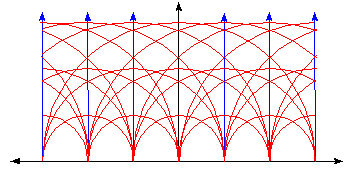
In fact, it is shown in the accompanying worksheet that the
geodesics of the hyperbolic plane are vertical lines and semi-circles
centered on the x-axis. That is, semi-circles centered on the x-axis and
vertical lines are the ''straight lines'' in the Poincare half-plane.
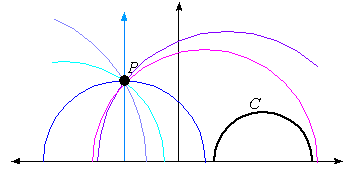
Given a semi-circle C and a point P not on the semi-circle, there are infinitely many other
semi-circles centered on the x-axis that pass through P. This
means that in the Poincare half plane, there are infinitely many
''parallel lines'' to a given ''line'' l through a point P not on l.
We say that the geometry of the Poincare half-plane is non-Euclidean because
it does not satisfy the parallel postulate that is foundational to Euclidean
Geometry.