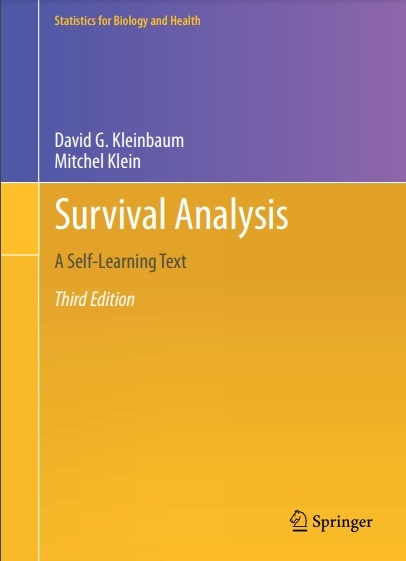
Copies of the classnotes are on the internet in PDF format as given below. The "Proofs of Theorems" files were prepared in Beamer. The "Printout of Proofs" are printable PDF files of the Beamer slides without the pauses. These notes and supplements have not been classroom tested (and so may have some typographical errors).
Survival Analysis (STAT 5750) has a formal prerequisite of Linear Algebra (MATH 2050) and permission of the advisor or the instructor. The catalog discription is: "Topics include concepts of time-to-event data, the hazard and survival functions, censoring mechanisms, non-parametric, semi-parametric, and parametric estimations and inferences, and comparison of survival curves." These descriptions are based on the ETSU 2019-20 Undergraduate Catalog.
Chapter 1. Introduction to Survival Analysis.
- Section 1.1. Introduction.
- Section 1.2. Abbreviated Outline.
- Section 1.3. Objectives.
- Section 1.4. Presentation.
- Section 1.5. Detailed Outline.
- Section 1.6. Practice Outline.
- Section 1.7. Test.
- Study Guide 1.
Chapter 2. Kaplan-Meier Survival Curves and the Log-Rank Test.
- Section 2.1. Introduction.
- Section 2.2. Abbreviated Outline.
- Section 2.3. Objectives.
- Section 2.4. Presentation.
- Section 2.5. Detailed Outline.
- Section 2.6. Practice Outline.
- Section 2.7. Test.
- Study Guide 2.
Chapter 3. The Cox Proportional Hazards Model and Its Characteristics.
- Section 3.1. Introduction.
- Section 3.2. Abbreviated Outline.
- Section 3.3. Objectives.
- Section 3.4. Presentation.
- Section 3.5. Detailed Outline.
- Section 3.6. Practice Outline.
- Section 3.7. Test.
- Study Guide 3.
Chapter 4. Evaluating the Proportional Hazards Assumption.
- Section 4.1. Introduction.
- Section 4.2. Abbreviated Outline.
- Section 4.3. Objectives.
- Section 4.4. Presentation.
- Section 4.5. Detailed Outline.
- Section 4.6. Practice Outline.
- Section 4.7. Test.
- Study Guide 4.
Chapter 5. The Stratified Cox Procedure.
- Section 5.1. Introduction.
- Section 5.2. Abbreviated Outline.
- Section 5.3. Objectives.
- Section 5.4. Presentation.
- Section 5.5. Detailed Outline.
- Section 5.6. Practice Outline.
- Section 5.7. Test.
- Study Guide 5.
Chapter 6. Extension of the Cox Proportional Hazards for Time-Dependent Variables.
- Section 6.1. Introduction.
- Section 6.2. Abbreviated Outline.
- Section 6.3. Objectives.
- Section 6.4. Presentation.
- Section 6.5. Detailed Outline.
- Section 6.6. Practice Outline.
- Section 6.7. Test.
- Study Guide 6.
Chapter 7. Parametric Survival Models.
- Section 7.1. Introduction.
- Section 7.2. Abbreviated Outline.
- Section 7.3. Objectives.
- Section 7.4. Presentation.
- Section 7.5. Detailed Outline.
- Section 7.6. Practice Outline.
- Section 7.7. Test.
- Study Guide 7.
Chapter 8. Recurrent Event Survival Analysis.
- Section 8.1. Introduction.
- Section 8.2. Abbreviated Outline.
- Section 8.3. Objectives.
- Section 8.4. Presentation.
- Section 8.5. Detailed Outline.
- Section 8.6. Practice Outline.
- Section 8.7. Test.
- Study Guide 8.
Chapter 9. Competing Risks Survival Analysis.
- Section 9.1. Introduction.
- Section 9.2. Abbreviated Outline.
- Section 9.3. Objectives.
- Section 9.4. Presentation.
- Section 9.5. Detailed Outline.
- Section 9.6. Practice Outline.
- Section 9.7. Test.
- Study Guide 9.
Chapter 10. Design Issues for Randomized Trials.
- Section 10.1. Introduction.
- Section 10.2. Abbreviated Outline.
- Section 10.3. Objectives.
- Section 10.4. Presentation.
- Section 10.5. Detailed Outline.
- Section 10.6. Practice Outline.
- Section 10.7. Test.
- Study Guide 10.
Computer Appendix: Survival Analysis on the Computer.
- A. Stata.
- B. SAS.
- C. SPSS.
- D. R Software.
Return to Bob Gardner's home page