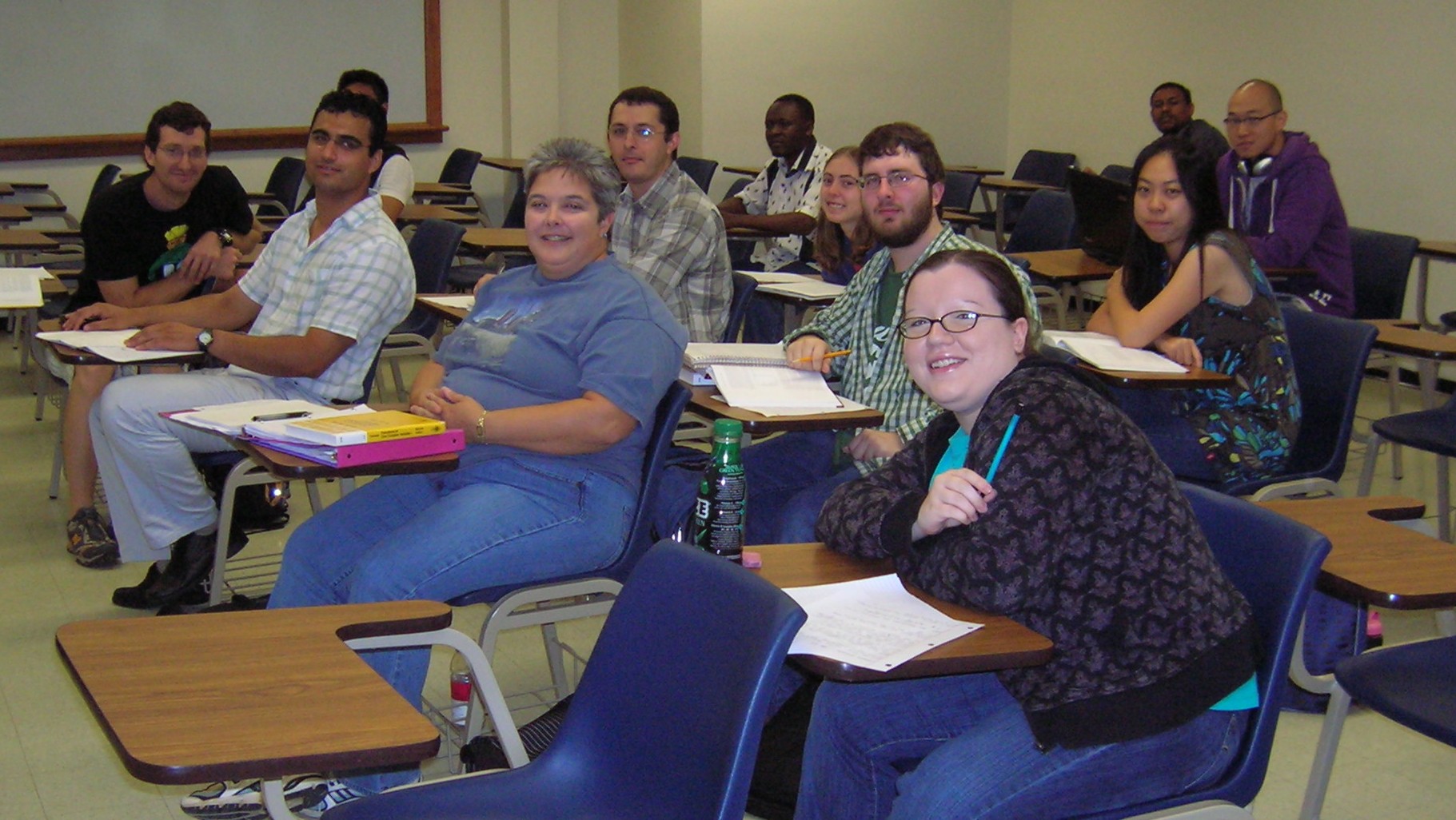
COURSE: MATH 5510
TIME: 9:45-11:05 TR
PLACE: Room 124 of Rogers-Stout Hall
CALL # 81392
INSTRUCTOR: Dr. Robert Gardner
OFFICE: Room 308F of Gilbreath Hall
OFFICE HOURS: 10:15-11:15 MWF
PHONE: 439-6979 (Math Office 439-4349)
E-MAIL: gardnerr@etsu.edu
WEBPAGE: www.etsu.edu/math/gardner/gardner.htm (see my webpage for a copy of this course syllabus and updates for the course).
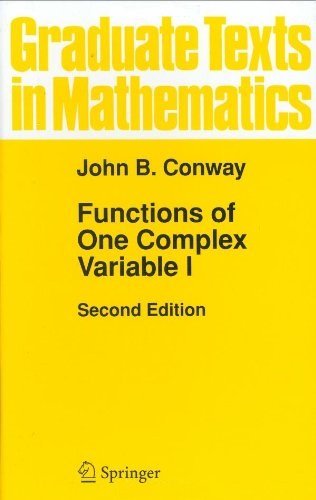
TEXT: Functions of One Complex Variable, Second Edition, by John Conway.
PREREQUISITE: An undergraduate real analysis class or advanced calculus class.
ABOUT THE COURSE: It will be assumed that the student has been exposed to (and has a reasonable recollection of) the topology of R (open and closed sets, limit points, connectedness, compactness, completeness, lub and sup, glb and inf, sequences and series of real numbers, convergence, uniform convergence, comparison tests, Cauchy sequences), and properties of functions of a real variable (continuity, differentiability, power series representation). It is also assumed that the student has been exposed to some elementary properties of the complex numbers (algebra, geometry, roots of unity, modulus) and functions of complex variables.
SOME NON-STANDARD TOPICS: Since ETSU only has a masters program in math, there are a few topics central to mathematics which are not covered in their own classes. Two of these are metric spaces and hyperbolic geometry. We will give a brief presentation of metric spaces (and their topology) in Chapter 2 of our text. We will use the complex analysis topic of Mobius transformations to lead into the topic of hyperbolic geometry. You will be given a handout related to Chapter 5 of Geometry with an Introduction to Cosmic Topology by Michael Hutchman (Boston: Jones and Bartlett Publishers, 2009). We will discuss the Erlangen Program of geometry which is due to Felix Klein and which emphasizes an approach to geometry based on sets of transformations.
OUTLINE:
Our tentative (and ambitious) outline is:
Chapter 1. The Complex Number System: introduction to the
complex plane, real and imaginary parts, modulus, polar representation,
extended complex plane, Riemann sphere.
Chapter 2. Metric Spaces and Topology of C: extensions of
several ideas from R to C and other metric spaces, open and
closed sets, connectedness, sequences, completeness, compact sets,
continuity, convergence, uniform convergence.
Chapter 3. Elementary Properties and Examples of Analytic
Functions: series, convergence of series, differentiability, analytic
functions, mappings.
Hyperbolic Geometry (based on Chapter 5 of Geometry with an Introduction to Cosmic Topology):Hyperbolic transformation groups, hyperbolic reflections, hyperbolic lines, triangles, measurement and arc-length in hyperbolic geometry, areas, trigonometry and hyperbolic trig functions.
Chapter 4. Complex Integration: Riemann--Stieltjes integrals,
power series, zeros of analytic functions, Fundamental Theorem of Algebra,
Maximum Modulus Theorem, winding number, Cauchy's Integral Formula,
properties of path integrals, Open Mapping Theorem.
GRADING: Homework (H) to be turned in will be assigned regularly. We will have two tests (T1 and T2) and your average will be computed as follows:
IMPORTANT DATES:
Monday, September 7 = Labor Day Holiday.
Friday, September 11 = Last day to drop without a grade of "W."
Friday, September 11 = Last day for 75% refund.
Monday, October 19 = Fall Break Holiday.
Monday, October 26 = Last day to drop without dean's permission.
Thursday and Friday, November 26 and 27 = Thanksgiving Holiday.
Wednesday, December 9 = Last day to withdraw from the university.
Friday, December 11 = Last day of class.
Tuesday, December 15 = Final, 10:00 a.m. to noon in Gilbreath 304.
OTHER RESOURCES. The following were mentioned in class:
HOMEWORK.The following homework is assigned:
Return to
Bob Gardner's webpage
Last Updated: December 12, 2009.